VR vs AR vs MR: The Differences and How Brands Use Them
By: Harikalar
Virtual reality (VR) replaces the real world with a fully computer-generated one; augmented reality (AR) keeps the real world in view and layers digital content on top of it; mixed reality (MR) anchors digital objects in the real space so you can interact with them as if they were there. The core difference is how much of the physical world stays part of the experience. Extended reality (XR) is the umbrella term for all three.
What is virtual reality (VR)?
VR uses a headset that covers your entire field of view and places you inside a digital world. Turn your head and the scene turns with you; hand controllers let you grab, push or slice objects. Because the real surroundings disappear, immersion is at its highest.
VR's strength is taking people somewhere they could never physically go in a few minutes: a trip to Mars, a roller coaster, a building that does not exist yet. Its limits are that it usually serves one person at a time and cuts them off from the people around them.
What is augmented reality (AR)?
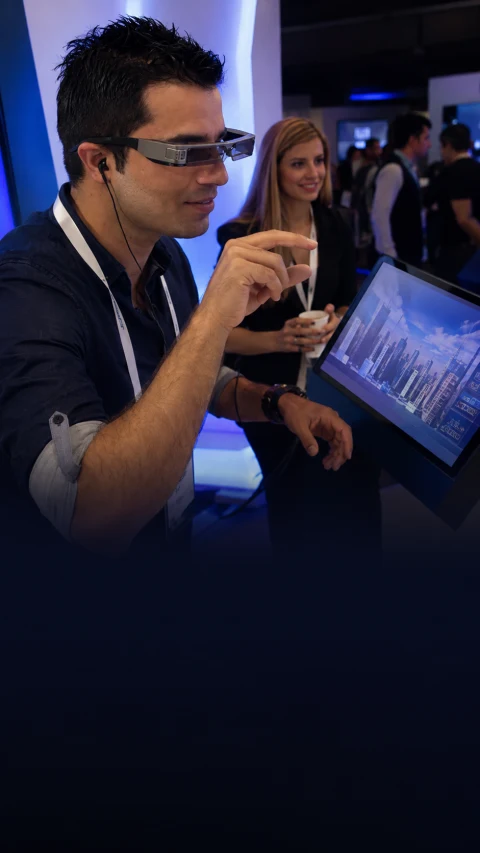
AR does not block out the world. Through a phone, tablet, screen or AR glasses, it adds digital objects, information or characters to what you already see. Viewing a 3D product model on a real table, or posing next to a digital character on a large screen, are both AR.
AR's advantage is reach: many set-ups run on guests' own phones or on a big screen that a whole crowd can watch. Immersion is lower than VR, but people stay connected to their surroundings and to each other.
What is mixed reality (MR)?
MR goes a step further than AR. Instead of simply overlaying graphics, a headset that maps the room places digital objects into the physical space, where they can sit in front of or behind real objects and respond to the user. You keep seeing the real world while sharing it with a digital character.
MR is ideal for building a digital story around a real product, revealing what is inside a machine, or adding a virtual guide to a physical experience.
XR: the umbrella term
Extended reality (XR) covers VR, AR and MR together. It helps to picture a spectrum: the fully real world at one end, a fully virtual world at the other. AR sits near the real end, VR at the virtual end, and MR in between, blending both at once.
VR vs AR vs MR at a glance
Virtual reality (VR)
- Device: an enclosed VR headset, usually with hand controllers.
- Immersion: highest; the user is entirely in a digital environment.
- Relationship to the real world: hidden; physical sensation (a motion seat, for example) can be added separately.
- Typical event uses: simulations, games, virtual venue tours, experiencing a product from the inside.
Augmented reality (AR)
- Device: phone, tablet, large screen or AR glasses.
- Immersion: moderate; the real world is always visible.
- Relationship to the real world: digital content is layered over the real view.
- Typical event uses: photos with digital characters, 3D product showcases, in-venue gamification.
Mixed reality (MR)
- Device: a spatially aware headset, either see-through or camera passthrough.
- Immersion: high, without losing the physical space.
- Relationship to the real world: digital objects are anchored in, and interact with, the real environment.
- Typical event uses: digital storytelling around a physical product, training and technical demos.
How brands use each at events
VR: experiences you feel with your body
At events, VR's power is transporting a guest somewhere else for a few minutes. A VR motion simulation chair syncs every turn and drop in the headset with a physically moving seat, with scenarios such as a Mars journey, a roller coaster or a brand-specific story. For something more playful and competitive, rhythm-based VR Beat Saber draws a crowd to the stand with a scoreboard and a live view for spectators.
AR: experiences open to the whole crowd
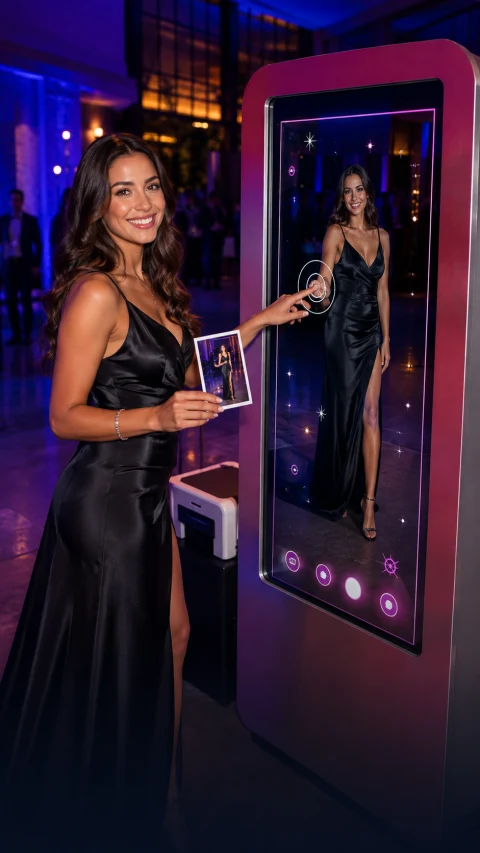
AR suits formats where anyone can join without a headset. An AR photo experience on a giant screen places digital characters, products or scenes next to the guest, with an instant print and a QR download. An AR treasure hunt played on phones starts with a QR scan, no app download, and turns a mall, museum or city into a playing field. For trade shows, showrooms and training, an AR glasses and tablet experience delivers 3D product presentations, information layers and interactive guidance.
MR: a story around the real product
One of the clearest examples of mixed reality at an event is the Dacia Mix Reality VR Roadshow. On a real off-road track built in 12 cities for the new Dacia Duster, guests chose one of two experiences. In VR, the track became a mountain, forest or desert while every move of the real car was mirrored in the headset. In mixed reality on Microsoft HoloLens, guests still saw the track, the windscreen and the driver, while a custom-designed Duster character explained the car's features mid-drive. According to the project page, 649 guests tried the VR or mixed reality experience. Running VR and MR side by side made the difference obvious: one takes you elsewhere, the other enriches where you are.
3D impact without a headset: holograms
Not every event suits headsets or glasses. A hologram cabin shows a 3D mascot, animation or human hologram using screen or fan technology, and can act as a greeter, a product showcase or a photo moment that reacts to movement. It is not strictly XR, but in busy spaces it creates a similar feeling of digital content living in the real world.
Which one should you choose?
- Want a deep, memorable moment? VR gives each guest a longer, more intense experience.
- Need to reach many people? AR on screens or phones involves more guests at once.
- Have a physical product to explain? MR adds a digital narrative without hiding the product.
- Is shareable output essential? AR photo set-ups flow straight to social media with instant prints and QR codes; with VR you will want to add a souvenir photo or a spectator screen.
Frequently asked questions
What is virtual reality?
Virtual reality (VR) is a technology that places the user inside a computer-generated environment through a headset that covers their entire view. The real world is hidden, and the user interacts with the digital space using controllers or body movement.
What is the difference between VR and AR?
VR blocks out the real world and takes you into a virtual one, while AR keeps the real world visible and adds digital content on top of it through a phone, tablet, screen or glasses.
How is mixed reality different from augmented reality?
In AR, digital content is mostly overlaid on the view. In mixed reality, a spatially aware headset anchors digital objects in the physical space so they are positioned among real objects and can be interacted with.
What does XR stand for?
XR stands for extended reality, the umbrella term covering VR, AR and MR.
Can VR and AR event experiences be customised for a brand?
Yes. Harikalar's VR and AR experiences can be designed around your brand in formats such as product presentations, venue tours, games or training scenarios.
Not sure whether VR, AR or mixed reality fits your launch, stand or roadshow? Get in touch and we will work it out together.
Get a Quote for Your Project
Contact us for experiences that will make your events unforgettable.