
What Is Team Building? Goals, Formats and Tech-Based Team Games
By: Harikalar
Team building is the practice of strengthening communication, trust and collaboration through planned activities in which colleagues work together towards a shared goal. It can take many forms, from workshops and outdoor challenges to technology-based competitions and game stations added to a corporate meeting. This guide explains what team building means, why companies do it, the main formats, and how to plan a session built around tech-based team games.
What does team building actually mean?
In a corporate setting, team building describes any activity where a group steps outside the daily workflow to get to know each other better, make decisions together and work towards a common result. The key word is "together": a good team building activity rewards teams whose members complement one another, not individuals who shine alone.
It isn't just entertainment. When designed well, a game creates a safe space to surface things that are hard to talk about at work, such as how roles are split, how people communicate and how the group decides under pressure.
Goals of team building
- Better communication: getting people from different departments talking outside the usual work vocabulary.
- Trust: letting team members practise delegating and relying on each other's decisions.
- Problem solving: building a strategy together under time pressure and clear rules.
- Integrating new teams: giving people who have just come together after a merger, growth or reorganisation a shared experience.
- Motivation: adding energy to kick-off meetings and end-of-period gatherings.
Team building formats: indoor, outdoor and in-event
Indoor team building
Held in a hotel ballroom, office or conference centre, indoor sessions don't depend on the weather, which makes them the go-to format in winter. Quizzes, strategy games and technology-based stations form the core of this format.
Outdoor team building
Outdoor programmes cover physical activities such as hikes, obstacle races and field games. Interest in team games tends to rise in late summer and early autumn, a natural window for outdoor events.
Team building inside meetings and kick-offs
Not every team building needs a separate day. Game stations placed between sessions of an annual meeting, a dealer conference or a kick-off break up long presentations and pull people back in. The "You Are the Leader" kick-off we designed for Borusan Logistics set out to turn a new-strategy message into something every employee could take ownership of, which is exactly what team building aims for.
Tech-based team games: 7 ideas
The biggest advantage of technology-based games over classic activities is that they're measurable: time, points and rankings appear on screen in real time, so there are no arguments about who won. Every game below runs with a scoreboard and suits an inter-team league.
1. Game of Brains: a focus duel
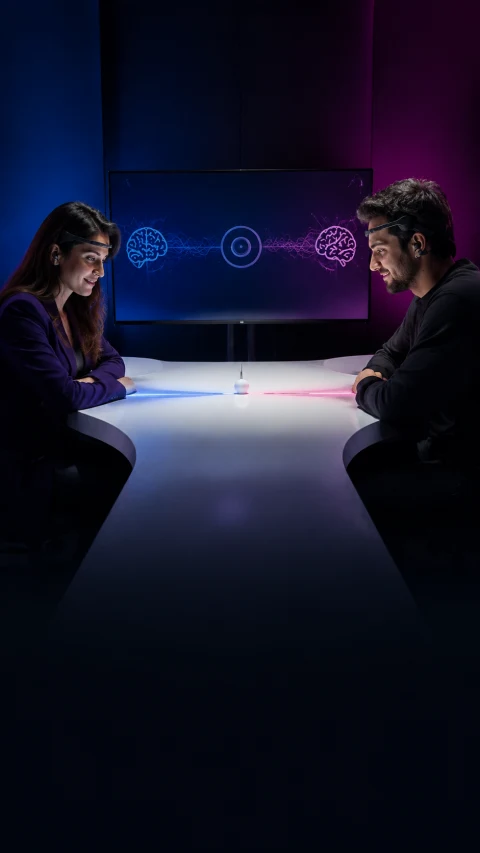
Two players wear EEG headsets and sit facing each other; whoever concentrates harder pulls a levitating object across the table to their side. The EEG-based mind game creates a quiet but surprisingly tense rivalry that spectators love. Teams can send representatives in a tournament bracket.
2. Quiz: turning knowledge into team points
A quiz on company culture, industry knowledge or general trivia lets every profile contribute. With a kiosk or tablet quiz, the question pool is written for your company and speed counts alongside correct answers.
3. Robot course: steer a robot with your body
Players steer a 45 cm robot through an obstacle course using body movements, racing against the clock. A motion-controlled robot course can easily become a communication game, with teammates calling out directions from the sidelines.
4. Slot car track: race with pedals or your voice
Slot cars can be controlled with a remote, a bicycle pedal or the power of your voice. In a voice-controlled race, the whole team shouting together speeds the car up, which makes the slot car track a genuine team game with several players at once. Lap times appear on the scoreboard.
5. Reflex wall: a relay format
On an LED sensor wall, the fastest person to hit randomly lit buttons wins. Because button count and difficulty are adjustable, the reflex wall works well as a relay: team members play back to back and points add up.
6. VR games: rhythm and courage
In VR Beat Saber, players slice cubes to the beat of the music while a big screen lets the audience follow along. The VR balance game tests nerve by asking players to walk a plank between skyscrapers; with teammates cheering them on, it speaks directly to trust.
7. Find the Pair: memory and division of labour
This memory game, played by flipping cards on a tablet or kiosk, can use your products or company values as card images, making it a good fit for onboarding days and new-starter meet-ups.
How to plan a team building event
Define the goal
Bonding, motivation or cross-department communication? The goal drives the choice of games. Communication-focused events favour games with spoken directions; competition-focused ones favour score-based stations.
Team size and number of teams
Keep teams small enough that everyone plays an active role. As headcount grows, add stations and rotate teams between them to cut waiting time.
Duration and rotation
Rather than staying at one game for a long time, build a rotation plan where every team tries every station within a set slot. Short rounds keep the energy up.
Scoring and prizes
Feed every station's score into one league table and announce results at the end. Prizes can cover categories like "best teamwork" as well as "highest score", so good communicators get recognised, not just the fastest players.
Venue and technical needs
Most tech-based games run on a standard power outlet and come with setup, testing and an operator. Confirming floor space and setup times with the venue in advance ensures the day starts smoothly.
Curious how game mechanics affect participation? Read our article on gamification and engagement.
Frequently asked questions
What does team building mean?
Team building is the practice of strengthening communication, trust and collaboration through planned activities in which colleagues work together towards a shared goal.
What are good team games for the workplace?
Quizzes, course and racing games, reflex and memory games, and VR experiences are the most common. Tech-based games show scores in real time, which makes it easy to run a league between teams.
Can team building be done indoors?
Yes. Indoor venues such as hotel ballrooms, offices and conference centres don't depend on the weather, so they are a popular choice for team building, especially in winter.
How long should a team building event last?
It depends on the goal and the number of participants. Game stations added to a meeting can run for a few hours, while full-day programmes work best with a rotating station plan.
How is team building pricing determined?
Each event receives its own quote, based on event duration, city and venue, the number of stations and any branding or custom content.
If you're planning a technology-based team building session, contact us and we'll prepare a tailored proposal and quote based on your goal, headcount and venue.
Get a Quote for Your Project
Contact us for experiences that will make your events unforgettable.